

cbd patch for back pain, cvs to sell cbd, oil pipes for cbd oil, how much cbd should i take daily, cbd oil arthritis inflammation, cbd butter recipe, keto and cbd oil, cbd vape juice dosage, highedt quality cbd oil, natures script, vet my pet, kats cbd oil, man up pills amazon, oil define, 99 store suppliers, purchase cbd oil near me, cbd oil from flowers, nih cbd oil, oral cbd products, cbd signs, cbd oil plus gold, is cbd legal in hawaii, cbd oil in dothan al, cbd deals, cbd flower buy, what does nt stand for in medical terms, sera labs cbd oil, cetirizine hci cbd oil, pax era cbd, cbd pellets for horses, cbd edibles effects, oils for nerve pain, best cbd oils, cbd hemp oil cream, ipuff cbd oil, ok google plus, best cbd cream for pain relief, topical cannabis arthritis, is hemp oil good for pain,
When most people think of Mexico, they picture beaches, colourful colonial towns and tacos. I firstly think of pyramids. And then tacos.
Mexico is one of the world’s greatest cultural destinations. This is because you can explore:
- Multiple civilizations rather than one empire.
- 1000 of years of continuous history.
- Excellent museums.
- UNESCO sites
What makes Mexico especially amazing as a cultural travel destination is the archaeology combined with colonial cities, delicious food and diverse nature. Mexico has it all.

Long before the Spanish arrived, Mexico was already home to some of the world’s greatest civilizations. The Maya, Zapotecs and Aztecs built monumental cities, sophisticated temples and thriving trading networks that still amaze visitors today. During a 3 week long round trip in 2016, I explored many of these ancient sites—from the vast ceremonial city of Teotihuacan near Mexico City to the hilltop ruins of Monte Albán, the hidden Palenque and the iconic and best-know pyramid of Chichén Itzá. And I encourage you to explore beyond Chichén Itzá.
These are the places that brought ancient Mexico to life for me. If you love history and archaeology, Mexico is hard to beat. That is why it is on my Top 10 Cultural Travel Destinations for 2026
Table of Contents
Discover Ancient Mexico: The Pyramids, Cities and Civilizations That Shaped a Nation
Mexico is one of the world’s richest destinations for cultural travellers. Across the country you’ll find ancient cities, UNESCO World Heritage Sites and museums that tell the story of civilizations stretching back thousands of years.
Mesoamerican civilization developed over thousands of years in what is now Mexico and Central America. They made permanent settlements around 3500 years ago. The Olmec were the first major civilization, followed by cultures including the Zapotec, Maya, Aztec, Teotihuacán and Toltec, each developing distinctive traditions in architecture, writing, astronomy, mathematics and trade. And developing farming and agriculture—especially maize, beans and squash. Thanks for those. And most importantly: cocoa.
This is the story of four distinct civilizations through places I’ve actually visited, rather than an exhaustive list.
Ancient Civilizations at a Glance
Civilization | Where I visited |
Teotihuacan civilization | Teotihuacan |
Mexica (Aztecs) | Mexico City |
Zapotec | Monte Albán |
Maya | Palenque & Chichén Itzá |
What surprised me most was how different the sites felt. They’re often grouped together as “Mexican pyramids,” but each belonged to a different civilization with its own architecture, beliefs and history.
One feature I never grew tired of was the ancient ball courts for the Mesoamerican rubber ball game, a sort of gladiatorial sport of sacrifice and symbolic warfare. Found at several archaeological sites across Mexico, they held deep religious and political significance. They became one of my favourite things to look for at every site. It must have been very hard to get a stone up there using your hip. And the punishment could be death if you lost.
1 Teotihuacan – Mexico's Most Impressive Ancient City

If I could only revisit one archaeological site in Mexico, it would be Teotihuacan. The temple pyramids of Teotihuacán are bucket-list, top World Heritage Site and wonder list material.
Long before the Aztecs ruled Mexico, another civilisation built one of the largest cities in the world. Its original name is lost to history, but when the Aztecs discovered the abandoned ruins centuries later, they called it Teotihuacan – “the place where the gods were created.” Even today, archaeologists are still debating who founded this extraordinary city, adding to its mystery.
And it does feel otherworldly. This was the place in Mexico I was most excited to visit. And it did not disappoint. Now I just want to go back.

The Avenue of the Dead
Walking along the immense Avenue of the Dead between the Pyramid of the Sun and the Pyramid of the Moon is one of the most memorable experiences I’ve had anywhere. What a name for an avenue.
But the place is huge and I recommend exploring the other temples and pyramids at the site as well. Like the Temple of the Feathered Serpent.
The sheer scale is difficult to appreciate until you’re standing there. It remains one of the largest ancient cities ever built in the Americas and is easily one of the most impressive archaeological sites I’ve visited anywhere in the world.


Human sacrifice
Excavations on the site and of the temples reveals a darker side. Human and animal sacrifices were buried beneath all three pyramids as part of their construction. The large series of sacrificial victims excavated from the Feathered Serpent Pyramid includes around a 100 soldiers. They were kneeling with their hands bound behind their backs. Many had necklaces of shells carved to look like human teeth; a few were made of actual teeth. Definitely a place for a dark tourist like me.

It has been guessed that the Ciudadela plaza may have served as a ballcourt.
The whole area is laid out on geometric and symbolic principles. As one of the most powerful cultural centres in Mesoamerica, Teotihuacan extended its cultural and artistic influence throughout the region, and even beyond.
After Teotihuacán’s decline, the Toltecs dominated central Mexico, followed by the Aztecs, who became the region’s dominant power in 1428.
2: Mexico City – The Aztec Capital Under a Modern Capital
You will probably start your travels in the capital Mexico City. Also here are the traces of the past.
Beneath the modern capital lie the remains of the Aztec capital of Templo Mayor, but the real highlight is the National Museum of Anthropology.

Tenochtitlan – The Lost City on the Lake
When the Spanish first saw Tenochtitlan in 1519, they could hardly believe it existed. Built on islands in Lake Texcoco, it was connected to the mainland by causeways and criss-crossed by canals.
The conquistador Bernal Díaz del Castillo later wrote:
The moment we arrived in this immense market, we were perfectly astonished at the vast numbers of people, the profusion of merchandise which was there exposed for sale, and at the good police and order that reigned throughout. The grandees who accompanied us drew our attention to the smallest circumstance, and gave us full explanation of all we saw. Every species of merchandise had a separate spot for its sale. We first of all visited those divisions of the market appropriated for the sale of gold and silver wares, of jewels, of cloths interwoven with feathers, and of other manufactured goods; besides slaves of both sexes.
Bernal Diaz
At its height, Tenochtitlan may have been one of the largest cities in the world, with perhaps 200,000 inhabitants—larger than most European capitals. Today, almost all of it lies buried beneath modern Mexico City. But I recommend reading Bernal’s memories. That is first hand experience of ancient Mexico.
He even admitted that many soldiers wondered whether they were dreaming. It also describes the impressive sanitary system and not forgetting the blood and other things after the many human offerings.
The walls and floor around this idol were also besmeared with blood, and the stench was worse than in a Spanish slaughter-house. Five human hearts had that day been sacrificed to him.
Bernal Diaz
Templo Mayor – The Heart of the Aztec Empire
Just a few metres from the Zócalo lie the remains of Templo Mayor, the religious heart of Tenochtitlan. This enormous stepped pyramid was dedicated to two gods: Huitzilopochtli, the god of war and the sun, and Tlaloc, the god of rain.
The gods are very distinct, but we bought a set of playing card with the gods and elements instead of spades and hearts and so on and it’s impossible to use.
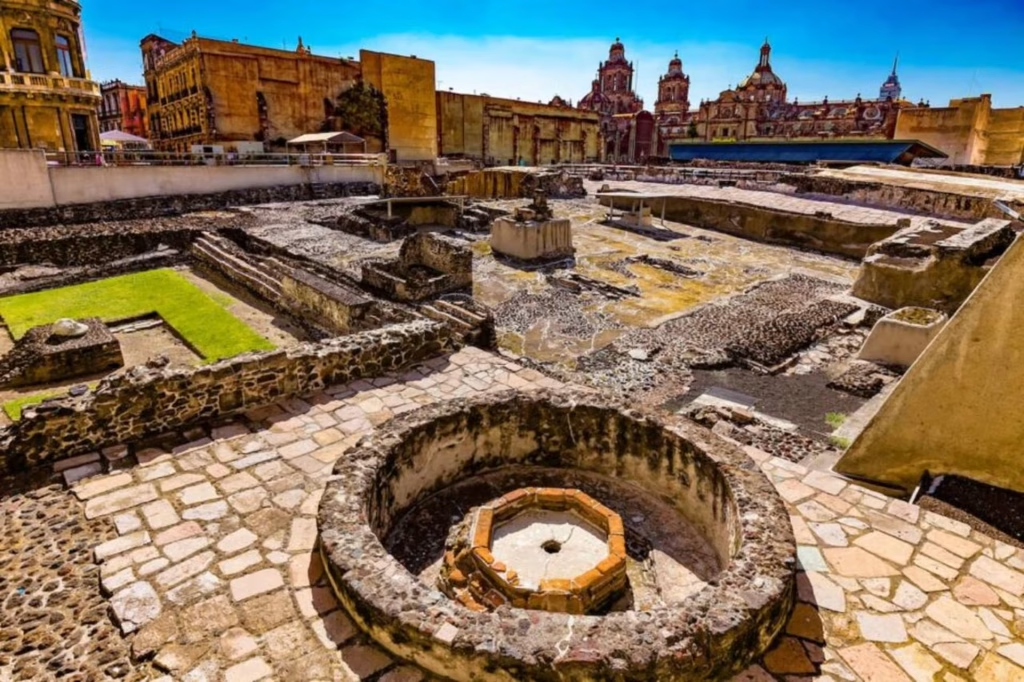
Like many medieval cathedrals, the temple wasn’t built just once. Each ruler enlarged it, building a new pyramid on top of the old one. Archaeologists have uncovered more than 180 ritual offerings beneath the temple, including jade, shells, obsidian, sacrificed animals and human remains. It is one of the most important archaeological discoveries in the Americas and offers a fascinating glimpse into the beliefs of the Aztec world.
Very unlucky and surprising and still saddening me, it was closed when we visited due to the festivities concerning the Day of the Dead. Luckily, you can see most of it from the street level. But not the museum. Another reason to re-visit.
The National Museum of Anthropology – Mexico's Greatest Museum

The National Museum of Anthropology is one of the finest archaeology museums in the world and, in my opinion, an absolute must-see. I had never seen art like this before. The museum brings together masterpieces from civilizations across Mexico, providing the context that makes the country’s ancient sites even more rewarding to visit. I visited the museum first, but would recommend doing it the other way around. But either works.


It houses the greatest collection of pre-Hispanic art in the country. Highlights include the enormous Aztec Sun Stone (often mistakenly called the Aztec Calendar), the colossal Coatlicue statue, the giant Olmec heads, the reconstructed tomb of the Maya king Pakal, and treasures from Teotihuacan, Monte Albán and countless other ancient cities.
Plan at least half a day. You could easily spend an entire day here.
Spanish conquest

The Aztec empire was conquered by the Spanish under Hernán Cortés (whom Bernal Diaz was fighting along) in 1521, bringing the long pre-Columbian era to an end.
The Spanish didn’t simply conquer Tenochtitlan—they built Mexico City directly on top of it. You can still trace the conquest throughout the historic centre. The Metropolitan Cathedral was constructed using stones from demolished Aztec temples. The National Palace stands where Moctezuma’s palace once stood, while the excavated Templo Mayor reveals exactly how the two worlds collided.

Walk through the Zócalo and you’ll see colonial churches standing beside Aztec ruins—a powerful reminder that modern Mexico City was literally built on the foundations of an empire.
You can spend days in Mexico City and still only scratch the surface of its history. Gotta go back.
3 Monte Albán – Mexico's Quiet Treasure
Perched high above the Oaxaca Valley, Monte Albán was perhaps the most peaceful archaeological site I visited in Mexico. The Hilltop City of the Zapotecs is even still not that well-known, but probably more than when I visited.
The setting is almost as impressive as the ruins themselves. Standing high above the valley, it’s easy to understand why the Zapotecs chose this location. It is of course also a UNESCO Site.

The Zapotec were one of the major civilizations of ancient Mesoamerica, centred in the Oaxaca Valley of southern Mexico. Their most important city was Monte Albán, founded around 2500 years ago on a spectacular mountaintop overlooking the valley. It became a major political, religious and economic centre and one of the earliest large cities in Mesoamerica. The Zapotec developed one of the region’s earliest known writing systems and calendars, and their carved stone monuments record rulers, rituals and probably military victories. Unlike Teotihuacán, Monte Albán was built directly into the landscape, with enormous terraces, plazas, temples and tombs carved into the mountain.

170 tombs
Here you’ll also find a dark story. The grim sides are not all there is too the religion and culture of these ancient civilizations, but they are very fascinating for a dark tourist like me. What could be more important than human life, I wonder.
Monte Albán contains more than 170 underground Zapotec tombs, many built beneath the courtyards of family homes. The most famous are Tomb 7 with more than 500 objects including gold, jade and crystal, and Tomb 104, known for its colourful murals of gods and ancestors. Many tombs have an entrance room, burial chamber and carved stone decoration.
Most tombs are unfortunately now closed, but you can see the archaeological remains at Monte Albán. The spectacular Tomb 7 treasure is displayed in Oaxaca City, while other important Zapotec objects, including jade masks, can be seen at the National Museum of Anthropology in Mexico City as mentioned above.

The Zapotec people never really disappeared. But their great civilization gradually declined. Around 700–900, it lost its political importance, probably because of resource pressures, drought and internal conflict. Like Angkor and other great empires.
From the 15th century, the Zapotecs eventually had to pay tribute to the Aztec Empire. When the Spanish arrived in the 16th century, the Zapotec ruler Cosijoeza allied with them against the Aztecs, but he was betting on the wrong horse. European diseases such as smallpox devastated the population.
The political kingdom disappeared, but the people did not: more than 400,000 Zapotec descendants live in Mexico today, and Zapotec languages are still widely spoken in Oaxaca. History shapes the present world you’re tavelling through.
4 Palenque – The Most Atmospheric

If Teotihuacan impressed me the most, Palenque was my favourite. Palenque is one of the most spectacular Maya archaeological sites in Mexico, with more than 500 buildings.
Hidden deep within the rainforest of Chiapas, it feels completely different from Mexico’s other great archaeological sites. As I explored the temples, scarlet macaws flew overhead and howler monkeys made the trees come alive. Somewhere beyond the jungle, jaguars still roam. It’s one of those places where the surrounding landscape is almost as captivating as the ruins. Like in Angkor in Cambodia.


The concept of zero
The Maya civilization was a major Mesoamerican culture that thrived from 2000 BC to the Spanish conquest. Famous for monumental step-pyramids, advanced mathematics including the concept of zero (genius), hieroglyphic writing, and precise astronomical calendars. The Maya occupied southeastern Mexico, but also Guatemala, Belize, Honduras, and El Salvador (which are of course on my list for upcoming trips).

Palenque’s greatest period was around 600–800, when it became an important Maya centre. The highlights include the Palace, the Temple of the Sun and the Temple of the Inscriptions, built as the tomb of the ruler Pakal.
As you might have guessed, I especially enjoyed exploring the royal tombs, including the beautifully preserved Temple XIII, often associated with the so-called Red Queen. Combined with the elegant palace complex and ball court, Palenque became the site that stayed with me long after I left. I also included the red queen in my Dark Tourism: 15 Must-Visit Tombs and Mausoleums as well as 24 Unsung World Heritage Sites in the Top UNESCO Countries
5 Chichén Itzá – A Mayan Wonder of the World

No matter how many pictures you’ve seen, Chichén Itzá is still a place you have to experience for yourself. The iconic Pyramid of Kukulcán is one of the world’s most recognizable ancient monuments. The big ceremonial complex is one of the New Seven Wonders of the World (alongside Taj Mahal and others). Finally, it is the most visited place in Mexico.
Despite the crowds, I wouldn’t skip it.


Kukulcan
Chichén Itzá was a major Maya sacred and pilgrimage centre, founded by the Itzá around the 5th century. The city flourished again from around 900–1200 with strong central Mexican/Toltec influences.
The famous pyramid of Kukulcan or El Castillo is around 30 meters high. There are 365 steps – one for everyday in the year. Chichén Itzá is much more though. The site contains around 25–26 major structures, including the Temple of the Warriors, El Caracol (the Observatory) and the Great Ball Court. The ball game is particularly fascinating because I had already seen similar courts at other Mesoamerican sites, showing how widespread this ritual was.

The Sacred Cenote is another reminder that this was not only a ceremonial centre, but also a place where ritual sacrifices took place. The door to the Underworld. After I learned this I haven’t dared to swim in a cenote anywhere. For anyone interested in dark tourism, it offers a fascinating glimpse into the religious practices of the Maya.
The city declined and was abandoned around the 13th century, but remained a pilgrimage site for centuries. By the time the Spaniards conquered the area, most of the Maya had become farmers living in villages.
Final thoughts on ancient Mexico

Mexico’s ancient cities are far more than impressive pyramids. Each belongs to a different civilization with its own story, from the mysterious builders of Teotihuacan to the Zapotec rulers of Monte Albán, the Aztec capital beneath Mexico City and the Maya temples of Palenque and Chichén Itzá.
What I enjoyed most was discovering how varied ancient Mexico really is. Every region revealed a different culture, different architecture and a different chapter of the country’s history.
As a cultural traveller, Mexico is one of those destinations that I would like to go back to. I’ve explored many of its greatest archaeological regions—but I know there are many more waiting for me. And I haven’t even included the food which is edible culture. I could not live without chocolate.
I visited in the beginnig of November. Dive deeper into the season in Should You Travel to Mexico for Day of the Dead?
Related
Discover more from The Travelling Dane
Subscribe to get the latest posts sent to your email.