

Updated in September 2026
If you’re like me and travel for culture, history and museums, Stockholm is a very good city to visit.
I’ve been to Stockholm five times – including two trips where I was there for work and spent most of my time visiting museums, and another focused on Stockholm’s UNESCO World Heritage sites. The last trip gave me a Backstage Pass to Top Sights in Stockholm.
And despite all those visits, I still have museums on my list. That probably tells you something about Stockholm.

The city has a crazy number of museums, covering everything from Swedish history and royal life to modern art, photography, military history, music, technology and shipwrecks.
So this is an attempt to tell you which are the best museums in Stockholm. I haven’t visited them all, but definitely more than most. I’ve listed the museums I have visited and would recommend, along with a few that I would not go back to and some I want to visit.
Put on your good shoes and bring your glasses. There is a lot to see.
Table of Contents
MUSEUMS I WOULD NOT MISS
Vas Museum
If you only have time for one museum in Stockholm, this is the one I would make time for. This is one of my top 3 museums in the world!
You walk in and, before you even enter the enormous exhibition hall, you can smell the tar.
Then you see it.
A real 17th-century warship.

The Vasa Museum is built around the Vasa, a Swedish warship that sank on its maiden voyage in 1628. More than 300 years later, it was salvaged from the seabed, and an extraordinary amount of the original ship survives.
It is enormous.
You can walk around the ship on several levels and see the extraordinary wooden sculptures up close. Outside, the masts give you an idea of just how tall the ship would have been when complete.
And the story is wonderfully dark.


The Vasa sank in front of Stockholm’s harbour on its maiden voyage, killing people on board. It then spent 333 years underwater before being brought back to the surface.Talk about a dark tourism attraction.
I have also been lucky enough to see another side of the Vasa story. During a special event at the Marinmuseum in Karlskrona, I actually held part of the ship. Mindblowing to stand with history in hand
That made the story of Vasa feel rather different from simply looking at it behind glass.
The museum itself is excellent, too. It explains how Vasa was built, why it sank, how it was salvaged and the enormous conservation effort required to keep it alive.
And yes, you can still smell the tar.
This is one of my favourite museums in the world.

The Vasa Museum has even appeared in international lists of the world’s best museums; in 2015 it was ranked ninth in TripAdvisor’s list of the world’s top museums.
One important thing to remember is that the ship is still deteriorating, despite decades of conservation work. Keeping Vasa preserved is an ongoing scientific challenge.
My verdict: If you are interested in history, ships, archaeology or dark tourism, don’t miss it.
The Royal Palace
The Royal Palace is an obvious Stockholm sight, but it belongs in a museum guide too.
The enormous Baroque palace in Gamla Stan is not simply somewhere to admire the royal apartments from the outside. There are several museums and collections inside, including the Treasury, the Gustav III Museum of Antiquities, the Royal Apartments and the Tre Kronor Museum.

The Treasury is the obvious place to start if you like royal history. There are crowns, ceremonial objects and other treasures that belonged to Sweden’s monarchs. The antiquity museum also has a very nice collection and sees few visitors. But don’t make the mistake of thinking the palace is just about pretty rooms and royal bling.
Underneath the present palace are the remains of Tre Kronor, the medieval castle that was destroyed by fire in 1697. The Tre Kronor Museum gives you a glimpse of the palace that stood here before the enormous Baroque building you see today.
And then there is my favourite part.


THE ROYAL ARMOURY
The Royal Armoury is my second-favourite museum in Stockholm – and one of those places that might not sound like it is for you until you actually visit.
Even if you aren’t particularly interested in weapons or military history, I think there is a good chance you’ll find something here.
And if you are a dark tourist? You are going to love it.

The museum is full of objects connected to the Swedish royal family, and some of them have absolutely extraordinary stories attached to them.
My favourite story may be the strangest one. The king’s heart:
After the death of her husband, King Gustav II Adolf, Queen Maria Eleonora of Brandenburg was devastated. According to the story, she had his heart wrapped in a cloth and kept it in a golden coffin over her bed.
The heart became part of her grief and, apparently, part of her political struggle too. When she wanted to demonstrate the depth of her loss, she would bring it out and show it, helping her gain sympathy and, on occasions, more time before the question of who should rule could be settled.
The cloth that held the king’s heart is now displayed in the Royal Armoury. The outlines of the organ are still visible on the white fabric.

Or take Gustav II Adolf’s horse, Streiff. Streiff was the king’s horse at the Battle of Lützen in 1632 – the battle where Gustav II Adolf was killed. The horse survived and was brought back from the battlefield. Today Streiff is one of the few preserved royal warhorses in the world. There is something rather unsettling about standing in front of the actual animal that was there when the king died.
And then there is King Gustav III’s masquerade costume. Gustav III was shot at a masquerade ball in 1792. The costume he was wearing is in the Royal Armoury – and the bullet hole is still there.
That is the sort of museum object I come to Stockholm for. It isn’t simply an old object. It has a story that is gruesome, deeply personal and completely connected to the history of Sweden. For me, this is what makes the Royal Armoury so good. It isn’t just armour. It is royal life, death, murder, war, fashion, politics, grief and some genuinely bizarre historical stories – all sitting in the same museum.
Even if you don’t think you’re an armoury-museum person, give it a chance.
OTHER STOCKHOLM MUSEUMS I REALLY LIKE
Fotografiska
Fotografiska isn’t technically a museum. It is an exhibition centre devoted to photography. But I am including it anyway.
Housed in a former Art Nouveau industrial building from 1906, it has become one of Stockholm’s major cultural institutions since opening in 2010.
The reason I like it is simple: there is always world-class exhibitions.
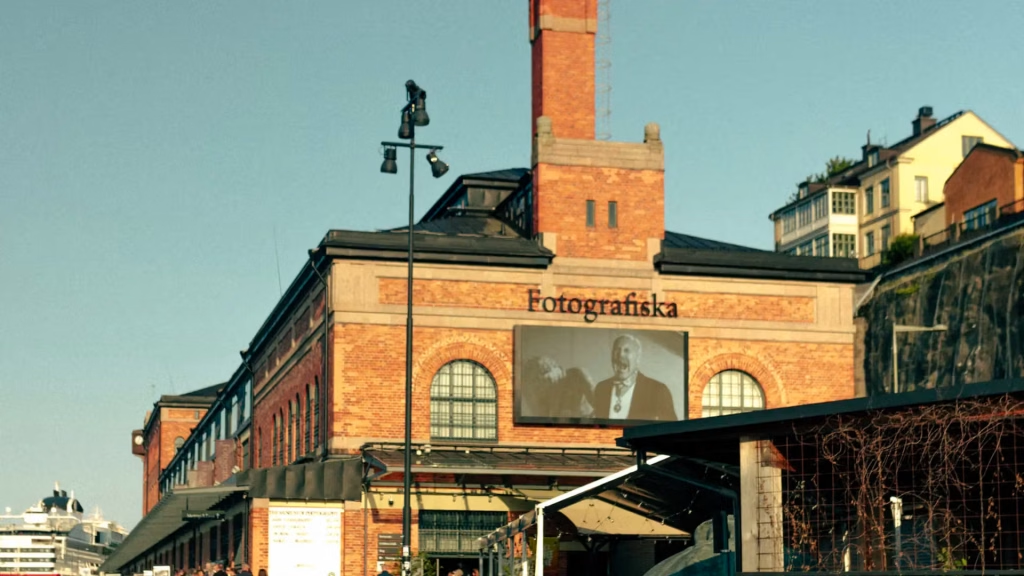
Several exhibitions run at the same time, mixing internationally famous photographers with less familiar names. So even if one exhibition doesn’t grab you, another probably will.
There is also a café, restaurant and bookshop, with great views over the harbour.
So Fotografiska is a good choice when you want something a little different from historical museums.
Swedish History Museum
The Swedish History Museum is a pretty good museum, but I would particularly recommend it if you are interested in medieval history or battles.
The medieval collections are where I found it most interesting, with medieval art, church treasures, textiles, jewellery and objects that make the period feel much more tangible. The museum’s Gold Room is also packed with Viking and medieval gold and silver treasures.
And then there is a different story involving the Danes, but this time the Swedes are the bad guys.

A Medieval massacre
If you like your history on the darker side, don’t miss “A Medieval Massacre” at the Swedish History Museum.
The exhibition tells the story of the Battle of Visby in 1361, when Danish King Valdemar Atterdag invaded Gotland. Around 1,800 Gotlanders were killed outside Visby’s walls. What makes it so chilling is the human remains. Skeletons from mass graves show horrific battle injuries, including deep sword cuts and axe wounds.
The museum also has 3D scans of some of the injured skulls. For me, this is exactly the kind of physical evidence that makes history feel real.


The stolen dress
The museum has a reconstruction of the famous golden dress associated with Queen Margareta I of Denmark, the powerful medieval queen who ruled Denmark, Norway and Sweden and created the Kalmar Union in 1397.
The story of how the dress ended up in Sweden is considerably less diplomatic.
The original was kept at Roskilde Cathedral, where Margareta I is buried. During the Danish-Swedish wars of the 1650s, Swedish forces looted the cathedral and took the precious dress. It eventually ended up in Uppsala, where the original is still preserved today.
The Swedish History Museum has a reconstruction, while the original can be seen at Uppsala Cathedral Museum.
As a Dane, I find that rather fascinating. You are standing in a Swedish museum looking at a reconstruction of a dress belonging to one of Denmark’s most powerful medieval queens – a dress that the Swedes took from the cathedral where she is buried.

That is Scandinavian history in a nutshell. And it is another reason why I think the museum works particularly well for anyone interested in medieval Scandinavia.
My verdict: A good museum overall, but one I would prioritise if medieval history or battles is your thing.
Nordic Museum
The Nordic Museum is another one I would recommend, particularly if you want to understand Sweden rather than simply look at famous objects.
It occupies that enormous, slightly intimidating building opposite the Vasa Museum on Djurgården, and its collections explore everyday life in Sweden and the Nordic countries from the 16th century to today.

What I particularly like is the temporary exhibition programme. There is often something that makes me want to stop and look rather than simply walk through a chronological collection.
The museum is also useful if you are interested in the details of everyday life: clothing, food, traditions, homes and the objects people actually used.
It is very easy to combine with the Vasa Museum since they are practically neighbours.
My tip: Don’t just go because the building is impressive. Check what’s on before you visit. The temporary exhibitions are one of the reasons I keep recommending it.
Tekniska Museum
I love a good science museum and I really enjoyed Tekniska Museet.
The museum focuses on technology, science and innovation, with a strong emphasis on interactive exhibitions. The museum has continued to develop that approach, and today it also includes Wisdome Stockholm, a large-scale visualisation and science experience.
What impressed me when I visited was how well it managed to make complicated subjects accessible without making them feel dumbed down.

This is particularly good if you are travelling with children, but I wouldn’t dismiss it if you’re an adult travelling without children.
Expect to spend several hours here.
But it is not as good as the Nemo in Amsterdam which you can explore in Beyond the Night Watch: Lesser-Known Museums in Amsterdam
Moderna Museet
If you like modern and contemporary art, add Moderna Museet to your Stockholm plans.
It sits on Skeppsholmen and has an excellent permanent collection, but what keeps me interested is the exhibition programme. I have found the temporary exhibitions consistently good. This same goes for its sister museum in Malmö.
So this is another museum where I would check what’s on before deciding whether to visit.
And the setting is lovely too. You get to walk across Skeppsholmen and explore the island as part of the visit.
Hallwyll Museum
This is one of the museums I particularly like recommending to people who have already done the obvious Stockholm sights.
The Hallwyl Museum is a magnificent townhouse in central Stockholm that belonged to the Hallwyl family. And you aren’t simply looking at their possessions in glass cases. You are walking through their home.


The rooms, furniture, collections and tiny details make it feel like stepping into another world. Like the billiard room. The billiard room was a natural gathering place for the men after an informal dinner. For those who did not participate the game there was a spectator seat in the wall-mounted bench. I want such a room for whisky and game nights.
Wilhelmina von Hallwyl was a serious collector, and the house became a museum after her death. Much of the interior has been preserved, making the whole place feel like a time capsule.
It is also surprisingly easy to miss. Which, of course, makes me like it even more.
Skansen
You cannot write about Stockholm museums without mentioning Skansen.
It is crazy popular, and for good reason. It is the world’s oldest open-air museum and combines historic buildings, demonstrations of traditional life and a zoo.
I enjoyed walking around Skansen.
But I have to admit that open-air museums are often more fascinating to me when the cultural heritage is further removed from my own.

As a Dane, Swedish traditional houses, crafts and everyday life are interesting – but they don’t always feel completely foreign.
That is probably why I tend to get more excited about open-air museums in places where the architecture, traditions and way of life are very different from what I know.
Still, if you are visiting Stockholm for the first time, Skansen is worth knowing about.

And, as a Dane, it is rather strange seeing Danes represented as the enemy.
The museum uses life-size scenes and figures to tell parts of the story. Some are surprisingly creepy. Which, admittedly, works rather well for me.
The museum is in central Stockholm, close to Östermalmstorg, so it is also an easy one to fit into a day of sightseeing.
Medieval Museum of Stockholm

One of the museums from my original Stockholm guide was the Medieval Museum, and I would still recommend it based on my visit.
But there is an important update: you can’t currently visit the museum in its old location.
The museum beneath Norrbro closed in November 2023 and is being relocated to Börshuset at Stortorget in Gamla Stan. There is currently no confirmed opening date.


The original museum was one of my favourites because it was built around archaeological remains and included reconstructed medieval streets, buildings, workshops and part of Stockholm’s old town wall. It felt much more like walking through medieval Stockholm than visiting a conventional museum.
For now, the museum runs tours and has a small seasonal Medieval Hub in Gamla Stan. So this is one to keep on your radar rather than putting on your current itinerary.
MUSEUMS I WOULD SKIP
ABBA The Museum
And then there is ABBA The Museum.
Yes, I went. And I know I am probably going to annoy some people now. I found it a little underwhelming.

Don’t get me wrong – I like ABBA. But I had expected more music and less about ABBA as people and personalities. Somehow, I wanted more of the songs, the recording process and the music itself, while I felt that quite a lot of the museum was about the four members.
That said, most people seem to absolutely love it, and I can understand why. It is interactive, colourful and very much about experiencing ABBA rather than simply looking at objects in display cases. So if you are a huge ABBA fan, you should probably ignore me and go. Maybe you’ll love it.
I just left thinking that I would have liked a little more ABBA the musicians – and a little less ABBA the people.
Swedish Army Museum

Armémuseum traces Swedish military history from the 16th century to the present and uses objects, uniforms, weapons, banners and life-size scenes to tell the story. There is also a room dedicated to Raoul Wallenberg.
What I particularly remember is that the museum isn’t simply about battles and weapons. It also explores the people affected by warfare – including hunger, suffering and propaganda.
It’s not that it is a bad museum. It’s just that there are so many others, and you’ll find better war exhibitions in Royal Armoury or History Museum. And not at least as good as the one in Paris with Napoleon’s death mask. (read more in 5 Dark Tourism Sites in Paris)
The Nobel Prize Museum
And finally, the museum I have deliberately avoided: The Nobel Prize Museum.
Why? Because, to be completely honest, it sounds boring to me. There. I said it.
I love history, science, literature and people who have changed the world. But the idea of a museum about prizes doesn’t immediately make me want to put on my shoes and head across Stockholm.
I may be completely wrong.

MUSEUMS STILL ON MY LIST
VRAK – Museum of Wrecks
This is the big omission from my Stockholm museum visits so far.
Vrak – Museum of Wrecks is still on my list, because it wasn’t open on my last visit.
As a dark tourist and a thinking the Vasa Museumis one of the best in the world, I gotta go. And now I have even more reason to go: in April 2026, Vrak was named Sweden’s Museum of the Year 2026 by the Swedish Museums Association and ICOM Sweden.
The museum focuses on the extraordinary maritime heritage lying on the bottom of the Baltic Sea. Rather than bringing wrecks up, it uses digital technology to tell their stories while leaving the wrecks where they are best preserved.
It is also right next to the Vasa Museum, and the two museums currently offer a combined ticket valid for 72 hours. (Vrak)
So yes.
I really need to visit this one.

AND THERE ARE STILL MORE
And this is really the problem with writing about Stockholm museums. There are so many: Thielska Gallery, Nationalmuseum, Stockholm City Museum, Viking Museum, Natural History Museum, Toy Museum and many others could all have their own sections here.
I simply haven’t visited enough of them yet to pretend otherwise. And that is actually one of the things I love about Stockholm. You can return again and again and still have somewhere new to go. For a cultural traveller, that is a pretty good reason to come back.
So which Stockholm museums should you visit?

My Stockholm Museum shortlist
If it is your first trip and you want the big cultural experiences:
- Vasa Museum – the one I would not miss.
- Royal Palace + Royal Armoury – especially if you like royal history, dark tourism or spectacular historical objects.
- Nordic Museum – particularly for its temporary exhibitions.
- Skansen – if you want Swedish cultural history in an open-air setting.
If you’ve already seen the obvious sights:
- Fotografiska – for photography.
- Tekniska Museet – for science and technology
- Hallwyl Museum – for a fascinating preserved home.
- Moderna Museet – for modern art and excellent temporary exhibitions.
And on my own next-time list:
- Vrak – Museum of Wrecks.
Stockholm has enough museums that you don’t need to try to see them all. Pick the ones that genuinely interest you. Then leave some for your next visit.
Because, judging by my five visits so far, you’ll probably need it.

More of Stockholm? Find UNESCO Sites and more in A Different Stockholm: Behind the Scenes at the City’s Cultural Icons. Museum lover like me? Find more inspiration in Discover Warsaw: Top 6 Museums You Must Visit
What’s your favorite museum?
Related
Discover more from The Travelling Dane
Subscribe to get the latest posts sent to your email.